retrievr is an experimental service which lets you search and explore in a selection of Flickr images by drawing a rough sketch.
~
Personally, I see retrievr more as an “exploration” tool than as a “search” tool, and it seems to work very well for that.
Java – Getting Started
Compiler vs. Interpreter
Compiler – Checks syntax.
Interpreter – Checks syntax.
Compiler – Generates machine-code instructions. Running the program is a separate step.
Interpreter – Executes the program statements as it converts them to machine-code.
Compiler – Is not needed to run the executable program.
Interpreter – Must remain installed while program is run.
Compiler – Runs faster.
Interpreter – Is slower.
Generally, when you compile a program, you’re creating machine language for a specific platform. For example, you might compile a program to run on a Windows 2000 platform. If you want to run the same program on an Apple computer, you can use a compiler that creates machine language for a Mac OS X platform.
When you compile a Java program, it doesn’t create machine language, it creates bytecode. To run a Java program, the computer running the program needs a Java Virtual Machine to convert the bytecode into machine language. This arrangement allows you to write once, then run anywhere that has a Java Virtual Machine.
Java programs can be written in any text editor, such as Microsoft Notepad. When you save a Java program, you should save it with a .java extension. For example, if you were to create a program that writes the famous phrase “Hello world“, you might save it as HelloWorld.java.
In addition to using the .java extension, you should use UpperCamelCase for the program name. CamelCase is the practice of writing compound words or phrases where the words are joined without spaces or dashes or underscores, and each new word is capitalized. The name comes from the camel-like “bumps” in the middle of the compound word that are created by the uppercase letters. When you name something in CamelCase that starts with a lower case letter, it’s referred to as lowerCamelCase. In Java, there’s a convention that you should use lowerCamelCase for variable names. On the other hand, names starting with an upper case letter are referred to as UpperCamelCase. The compiler, however, doesn’t care which case you use for any of these names, as long as you are consistent.
To compile Java programs using the Standard Edition 5.0 of the Java 2 platform, you need to download JDK 5.0 Update 6.
To compile HelloWorld.java, you type in javac HelloWorld.java at the MS-DOS Prompt (in Windows 95/98) or Command Prompt (in Windows NT/XP). This will create bytecode in HelloWorld.class.
To run HelloWorld.class, you type java HelloWorld.class.
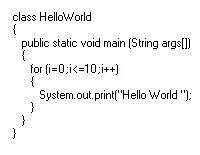
A HelloWorld program could look like this:
class HelloWorld
{
public static void main(String[] args)
{
System.out.println("Hello World");
}
}
The first line starts with the word class. This is just a reserved word that tells java that we’re building a new class. The other word on the first line is HelloWorld. This is the name that we have chosen for this class, and it MUST match the program name. By convention, all class names should be UpperCamelCase so programmers will recognize that it is a class name, not a variable name. The entire first line is a class header.
The second line of the program is an opening curly brace. This defines the beginning of the class body. The last line of our program is a closing curly brace. This indicates the end of our class. Everything between these two curly braces is part of class HelloWorld.
The HelloWorld class contains one method. Method is just another name for something that is called a function, procedure, paragraph, or subroutine in other languages. It’s a block of code that can be called from another location. In this case, it’s called from the run statement. All java applications start at a method named main().
The third line is a method header for the main() method. It’s followed by curly braces that define the body of the method and enclose a println statement that sends the literal “Hello World” to the screen.
This particular method starts with the word public. Public is an access modifier. It lets Java know who’s allowed to call this method. Public is the least restrictive access modifier.
The next word is static. Static changes main() from an instance method to a class method. Yes, I understand that you don’t know what this means yet.
Static is followed by the word void, which indicates that the main method doesn’t send a value back to the place that called it. If it did return a value, we would replace the word void with the data type of the returned value.
The method body contains a single statement:
System.out.println(“Hello World”);
It ends with a semicolon. All statements end with a semicolon. Class headers and method headers are not statements.
The word System is a class. It starts with an uppercase letter.
The word out is an object.
The word println() is a method.
The statement System.out.println(); is a method call.
The statement System.out.println(“Hello World”); is a method call that passes a literal argument to the method.
If you’ld like to try it for yourself, here are some good instructions and a closer look at a Hello World program from the folks at Sun.
A good learning path would be to continue writing Applications.
Once you have a good foundation writing applications, you can start learning about Applets.
At some point, you may want to start using an Integrated Development Environment.
Here are some Java Tips.
Step by Step Programming.
Free University of Bolzano/Bozen.
Mississippi River Museum

Prepare to take an entertaining and informative journey on the Mighty Mississippi at the National Mississippi River Museum & Aquarium. Enjoy dynamic aquariums, historical exhibits and a stroll through the wetlands and boatyard. Each visit is a truly interactive experience where visitors can get “up close and personal” with live critters, become barge pilots, and control locks and dams.
The National Mississippi River Museum’s photo exhibit The Invisible Industry is currently on display at the Smithsonian Institution.
Hello World
This is a complete list of “Hello World!” programs written in more than 300 existing programming languages.
Evolution of a programmer.
Java Intro with Passion
This 6-week bootcamp course is designed to teach “basic but essential Java programming” to folks who are new to Java programming. This course can be taken by anyone who wants to learn Java programming. No programming experience is needed in order to take this course.
The 1st session will start from Jan. 16th, 2006.
Sang Shin also teaches J2EE Programming (with Passion!), and Advanced J2EE Programming (with Passion!).
Java API Spec
Mustang:
Java SE 6 rc-b65 Draft
Index
Java 2D
JDK Tools and Utilities
Listeners
Swing Components
Tiger:
J2SE v1.5.0
Index
Java 2D
JDK Tools and Utilities
Listeners
Swing Components
Prev:
J2SE v1.4.2
Index
Java 2D
JDK Tools and Utilities
Llisteners
Swing Components
Prev:
J2SE v1.3.1
Index
JDK Tools and Utilities
Llisteners
Swing Components
New Modality features
Barn
I’ve often heard people say, “I wish we could go back to Mayberry; back to a simpler time when life was far less complicated”. However, even a cursory glance at the decade of the original series run reveals anything but a simple lifestyle. ~ Do people really want to return to the events of the 1960s, or is there something about the attitude of this television show that provides the appeal?
~
If you are familiar with the series, it is not hard to think of an episode that portrayed a specific moral value. For example, Andy on Trial shows us the value of friendship and how easy it is to put our friendships at risk when we are concerned with exalting ourselves. The episode Opie the Birdman shows us the importance of taking responsibility for our actions, and how just saying “I’m sorry” doesn’t automatically fix everything. Mr. McBeevee gives us a very pointed lesson about trusting in one another and having faith, even when the evidence suggests otherwise. These examples and many more can be found throughout the series.
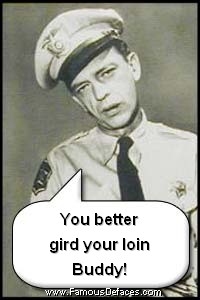
So, gird your loins for adventure.
More Cowbell

It’s the cymbal’s evil third cousin. It’s the dark ring that pounds in the back of your brain and lets you know, it’s time to rock.

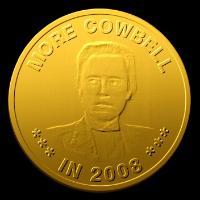
Christopher Walken wants More Cowbell in 2008.
Best of Joel’s Blog 2005

05/11/05 The Stinkymeat Project – The first day of Joel’s Blog.
05/12/05 Primate Programming
05/13/05 The Brick Testament
05/14/05 Anti-Dihydrogen Monoxide Coalition (ADMC)
05/14/05 Google Content Blocker
05/19/05 Elevator
05/22/05 Radioactive Boy Scout
05/24/05 Pimp my Ride – Pimp my Bride.
05/27/05 Prehistoric Shopping Cart
05/29/05 Giant Steps
06/02/05 Grocery Store Wars
06/04/05 Save the Rambler
06/08/05 The Hidden Words Stone
06/09/05 Heart of the Apple
06/20/05 Joie Chitwood
06/21/05 Iowa Pork
06/22/05 1957 Plymouth Belvedere
06/23/05 Lotus on eBay
06/24/05 Creep
06/30/05 Stubbies
07/07/05 Growth of a Nation
07/08/05 Museum of Depressionist Art
07/09/05 Gallery of the Unidentifiable
07/12/05 J-Walk Blog
07/19/05 Heavy Drinkers Guide to Iowa City
07/20/05 Banning 1324
07/20/05 Magic Makeover
07/21/05 World School Photographs
07/27/05 Bum Wines
07/28/05 B-Boy Junior a.k.a. Buana
08/01/05 The Dammed Mississippi
08/02/05 Living History Farms
08/03/05 Norman Borlaug Heritage Foundation
08/03/05 Global Rich List
08/10/05 Hemi Grill
08/13/05 Hillbilly Video
08/14/05 Annual Performance Review
08/16/05 JetKart
08/16/05 Strangelets
08/23/05 Playing With Fire
09/02/05 Tongue-eating bug
09/04/05 Origami Boulder
09/04/05 Drummers
09/12/05 Abbot Downing Company
09/14/05 Delusions of Self-Sufficiency
09/15/05 Advertising/Design Goodness
09/19/05 Petrol Direct
09/26/05 Stanislav Petrov
09/27/05 Space Elevator
09/29/05 Rainforest Iowa: Right For America, Right For Puppies
10/06/05 Atmospheric Vortex Engine
10/07/05 Tornado Attack Vehicle
10/11/05 Stupid Gravity
10/17/05 Empire State Building
10/20/05 Butterfly
10/22/05 Monk and Coltrane
10/27/05 Sizzling Organic Chemistry Dramas!
10/28/05 like no other
10/30/05 Drivers License Search
10/30/05 Troy Hurtubise
11/01/05 Missouri Spies on Drivers
11/05/05 Near Earth Objects
11/06/05 FlightAware Live Flight Tracker
11/10/05 NYSee
11/11/05 Fern
11/21/05 Jules
11/22/05 Land Speed Record
11/26/05 Dan Osman
11/29/05 A Sense of Scale
11/30/05 Jigsaw Puzzles
12/03/05 The Bicycle Forrest
12/04/05 Matchstick Marvels
12/04/05 One Red Paperclip
12/07/05 Trebuchet
12/09/05 Big Eye in the Sky
12/14/05 Science Toys
12/17/05 A Magical Fall
12/22/05 Pipe Dream
12/26/05 How to Procrastinate Well
12/26/05 Joels Blog in Art History
It was bound to happen eventually:
05/16/05 Jeff and Juhan’s RC Plane Website
12/05/05 Jeff and Juhan’s RC Plane Website
Best Products of 2005
Golf balls that don’t go missing, a computer pooch you needn’t pick up after, whole-grain white bread: 2005 brought a flurry of innovative surprises.