
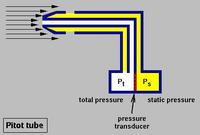
Pitot Tube

Pitot Tube

Pitot tubes are used on aircraft as speedometers. The actual tube on the aircraft is around 10 inches (25 centimeters) long with a 1/2 inch (1 centimeter) diameter. Several small holes are drilled around the outside of the tube and a center hole is drilled down the axis of the tube.

Converting the resulting differential pressure measurement into a fluid velocity depends on the particular fluid flow regime the Pitot tube is measuring. Specifically, one must determine whether the fluid regime is incompressible, subsonic compressible, or supersonic.

Using a tube to measure wind speed sounded so simple at first.

Skyliner

Skyliner

In 1954, Ford trumped the industry with the Crestline Skyliner, a hardtop that featured a tinted Plexiglas roof section. The glass top option continued for three years.

Ford Motor Company Produced the Retractable Hardtop “Skyliner” from 1957 through 1959.

SKYLINER, World’s only hide-way-hardtop! One minute this car is a snug, all-steel hardtop with smart Victoria styling. Touch a button and the roof vanishes into the rear deck…and you’re sitting pretty in an open convertible!

In 1957 Ford sold 20,766 Skyliners, helping the company beat Chevrolet for the sales leadership title that model year. For 1958 the Skyliner was revised with quad headlights but its styling was less dramatic compared to the competition, and sales dropped to 14,713. More styling tweaks plus an awkward name change occured in 1959. Dubbed the Ford Fairlane 500 Galaxie Skyliner, it attracted a mere 12,915 buyers.

Find an Old Skyliner and Restore it.

Or buy one:
1957 $17,500
1957 $28,000
1957 $31,000
1958 $??,???
1959 $32,950
1959 $37,000
1957 $48,000
1957 $110,000

Or rent one:
Clyde

Or make a custom:
Mustang

Deep Sky Objects

Tonights Sky

Your guide to constellations, deep sky objects, planets, and events.

Alas, we see very little outside our own backyard, a tiny neighborhood of our galaxy where the Sun is common, just another three-bed, two-bath star in the suburbs of the Milky Way. ~ Almost all of the sky objects visible to the naked eye are stars that reside in our galaxy.
~
There are roughly 300 billion stars in the Milky Way. ~ Roughly 2,500 stars are available to the unaided eye in ideal conditions from a single spot at a given time.
~
Clear and dark skies reveal a handful of nearby galaxies, but each is on the fringe of naked-eye visibility.

The Great Orion Nebula (M42, NGC 1976) and NGC 1977 to the north (left in this photo) are located in the ‘Sword’ part of the constellation of Orion, just below the Eastern-most of the three stars that comprise Orion’s belt. As well as being the brightest, M42 is perhaps the most famous and most photographed nebula in the night sky.

The Messier Catalog

CWT

CWT

Changing World Technologies (CWT) was founded in August 1997. Our purpose is to identify emerging technologies that specifically address the needs and problems in the energy and environmental arenas.

Renewable Environmental Solutions, LLC (RES) is currently operating the Carthage, Missouri plant.

Unlike other solid-to-liquid-fuel processes such as cornstarch into ethanol, this one will accept almost any carbon-based feedstock. If a 175-pound man fell into one end , he would come out the other end as 38 pounds of oil, 7 pounds of gas, and 7 pounds of minerals, as well as 123 pounds of sterilized water.

Snake Oil?