HSH Nordbank pre blue race

Roy Ger

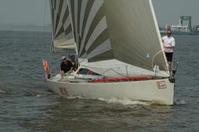
Some of Germany’s fastest racing yachts have been signed up to compete in the HSH Nordbank pre blue race, starting on 20th May. The participants face a great nautical challenge that requires all their skills and competence. Some of them take advantage of the ambitious course from Kiel to Hamburg round Skagen as a training opportunity for the 2007 North Atlantic Race.

On Saturday the 20th May at 10.00 a.m. Angelika Volquartz, mayor of Kiel, and the mayor of Hamburg Ole von Beust will fire the starting gun at Kiel/Germany.

Race Tracker

—

Update:

Video

The rain poured heavily down, but did not stop the excitement of the participants preparing for the first leg.

The “Roy”, a “Rainbow 42” will start with the oldest team in the race. Only bowman Ingo Trebian is an expectance, counting 27 years. “We will have a fast ride, looking at the weather and may sail up to 22 knots with our boat”, says skipper Werner Schulz. Reaching is the best course for “Roy”.

Faces became tight during the skippers’ briefing when the weather forecast predicted storm. ~ Where the Kattegat waters merge with the Skagerrak strait, the waves are prone to be particularly nasty on the yachts.

“We’ll be meeting up in Hamburg, and I trust that you will use the best of your seamanship to decide whether to get to the party on the Cap San Diego on your own keel or by car. Safety must come first at any rate”, race organizer Torben Knappe [said].

“Unfortunately, we’ll go home”, regretted Peer Valentin ~ who had been sailing on the Comfortina 42 Meltemi.

The oldest yacht of the fleet, Werner Schulz’ Roy, a Rainbow 42 from 1988 also stayed behind in Copenhagen for safety reasons.

[UCA] is now the undisputable overall winner of the HSH Nordbank pre blue race ~. The other 23 yachts gave up the race because of the heavy weather, but the spirits are high in Skagen, Denmark, where most of the yachts had sought shelter from the storm.


Big Sun

Big Sun

The Sun is a seething ball of gas, powered by nuclear reactions in a central core with a temperature of over 10 million degrees Kelvin.

Even though the diameter of the sun is about 400 times that of the moon, and it out-masses the moon by about 27 million times, they are both approximately the same apparent size in our sky

The several- days-long flight of the various Apollo missions in the ’60s and ’70’s would not even get them to two-thirds of the Sun’s radius, assuming that they started at the center.

It contains more than 99.8% of the total mass of the Solar System

Relating the size of the Solar system to familiar objects can make it easier for students to grasp the relative distances. Most classroom globes are 41 cm (16 inches) in diameter. If the Earth were reduced to this size, the Moon would be a 10 cm (4 in) baseball floating 12 metres (40 feet) away. The Sun would be a beach ball 14 stories tall (somewhat smaller than the Spaceship Earth ride at Epcot) floating 5 kilometres (3 miles) away.

The Boston Museum of Science has a model of the Solar System, and we’re not talking about a collection of ping-pong balls in a glass case in the museum. This is a really amazing 1-to-400 million scale model (1 inch equals 10,000 km), spread across the wider Boston area.

As the Voyager 1 spacecraft headed out of our Solar System, it looked back and took a parting family portrait of the Sun and planets. From beyond Pluto, our Solar System looks like a bright star surrounded by faint dots

There are 17 bodies in the solar system whose radius is greater than 1000 km.

If the sun consumes “x” amount of mass per second during nuclear fusion, and it is believed to be “y” years old, how big (diameter) was it believed to be when it was first “fired up”?

Posted in Uncategorized | 1 Reply

Lactic Acid

Lactic Acid

“It’s one of the classic mistakes in the history of science,” Dr. Brooks said.

Its origins lie in a study by a Nobel laureate, Otto Meyerhof, who in the early years of the 20th century cut a frog in half and put its bottom half in a jar. The frog’s muscles had no circulation – no source of oxygen or energy.

Dr. Myerhoff gave the frog’s leg electric shocks to make the muscles contract, but after a few twitches, the muscles stopped moving. Then, when Dr. Myerhoff examined the muscles, he discovered that they were bathed in lactic acid.

A theory was born. Lack of oxygen to muscles leads to lactic acid, leads to fatigue.

Athletes were told that they should spend most of their effort exercising aerobically, using glucose as a fuel. If they tried to spend too much time exercising harder, in the anaerobic zone, they were told, they would pay a price, that lactic acid would accumulate in the muscles, forcing them to stop.

Few scientists questioned this view ~.

When he graduated and began working on a Ph.D. in exercise physiology, he decided to study the lactic acid hypothesis for his dissertation.

“I gave rats radioactive lactic acid, and I found that they burned it faster than anything else I could give them,” Dr. Brooks said. It looked as if lactic acid was there for a reason. It was a source of energy. As for the idea that lactic acid causes muscle soreness, Dr. Gladden said, that never made sense.

In a paper in press for the American Journal of Physiology – Endocrinology and Metabolism, published online in January, Brooks and colleagues ~ link for the first time two metabolic cycles – oxygen-based aerobic metabolism and oxygen-free anaerobic metabolism – previously thought distinct.

“This is a fundamental change in how people think about metabolism,” Brooks said. “This shows us how lactate is the link between oxidative and glycolytic, or anaerobic, metabolism.”

“The world’s best athletes stay competitive by interval training,” Brooks said, referring to repeated short, but intense, bouts of exercise. “The intense exercise generates big lactate loads, and the body adapts by building up mitochondria to clear lactic acid quickly. If you use it up, it doesn’t accumulate.”

Experiments with dead frogs in the 1920s seemed to show that lactate build-up eventually causes muscles to stop working. But Brooks in the 1980s and ’90s showed that in living, breathing animals, the lactate moves out of muscle cells into the blood and travels to various organs ~.

Brooks always suspected, however, that the muscle cell itself could reuse lactate, and in experiments over the past 10 years he found evidence that lactate is burned inside the mitochondria, an interconnected network of tubes, like a plumbing system, that reaches throughout the cell cytoplasm.

What does this mean for my training? Lactate threshold is the most important determinant of success in endurance-related activities and events, therefore it’s improvement is the main goal of endurance training programs. By performing lactate threshold training, you are also directly increasing the calories you burn during this type of exercise program. This type of training is also highly recommended to enhance weight loss and weight management.

If you’re weightlifting, which is anaerobic, I’m not sure this changes anything. I believe it’s generally accepted that the ideal range is 8-12 reps in 1-3 sets, every other day. This means that one set of eight reps is in range. The main thing is to use the maximum weight that you’re able to lift with good form. When you can do a few more than eight reps, check to see if you can handle more weight.

Taxi Driver Interview

Both Apples

The driver was interviewed on TV after being mistaken for a specialist on music downloading.

The ~ interviewee was not Guy Kewney, the respected editor of Newswireless.net, but a local taxi driver.

It later emerged that the driver had been waiting for a client at the BBC Television Centre in West London, when a studio manager mistook him for the expert.

Mr Kewney, an IT journalist , watched as Mr Goma, whose identity remained a mystery until it was revealed on Monday night by the BBC, gamely attempted to answer questions fired at him by BBC consumer affairs correspondent Karen Bowerman.

Video Video2

Update: Not a taxi driver.

Morgellons Disease

Morgellons Disease

If diseases like AIDS and bird flu scare you, wait until you hear what’s next.

We refer to this infectious disease as “Morgellons Disease“, due to the need for a consistent label when contacting politicians and health departments.

Most individuals with this disease report disturbing crawling, stinging, and biting sensations, as well as non-healing skin lesions, which are associated with highly unusual structures.

Almost all, if previously seen by well-read physicians without prolonged observation, will have been labeled as “Delusional Parasitosis“.

Most doctors tell them it’s all in their heads.

Update:

From the Comments.

I thank God that I never heard of a stupid thing like ‘Morgellons Disease’ or unidentified skin parasites, back when I was ill. ~ I think it’s a crime and the most appalling perversion of truth that I’ve ever witnessed.

Update:
More Pictures

Hawkeye Point

Hawkeye Point

Mount Sunflower, Kansas. Ebright Azimuth, Delaware. Hawkeye Point, Iowa. Hoosier High Point, Indiana.

They may not have the name recognition of Mount McKinley (Denali), Mount Rainier, Mount Whitney, and Mount Hood. And they certainly are far, far easier to get to! But all these places have something in common. Each is the highest natural spot in its state.

DAWN WAS BUT A RUMOR on the eastern horizon when our climbing team set off from base camp, heading north toward a mountain so elusive it wasn’t even named until 1998. By 11:30 a.m., after a morning of steady advancement, our party of seven had gained the summit ridge. No one was showing signs of edema; we pushed for the top…

The Peak: 1,670 feet
The view is high on soy and corn and low on drama.

Formerly a cattle feedlot, the highpoint is at the end of the feed trough.

Map and Photos

Highpoints

Attempting to climb Panorama Point, the highest spot in the state of Nebraska.

Google Book Search

Google Book Search

Search the full text of books to find ones that interest you and learn where to buy or borrow them.

If the book isn’t under copyright at all, you can browse the entire book in the Full Book View, but the aim of Google Book Search is to help you discover books and learn where to buy or borrow them, not read them from start to finish. It’s like going to a bookstore and browsing – with a Google twist.

Printing and image copying functions are disabled on all Google Books pages.

~ As opposed to Google’s service, Project Gutenberg offers full texts to be easily copied. Google so far lets you browse through single pages, but no more than three per book – even for works that passed into the public domain ~.

The Argument