
The Knife wrote Heartbeats, the song covered to achey-breaky affect by fellow Swede Jose Gonzalez in the Sony Bravia ‘bouncing balls‘ commercial.
Then Tango did this.
Battlefield 2 and Rainbow joined in.
Now this.

The Knife wrote Heartbeats, the song covered to achey-breaky affect by fellow Swede Jose Gonzalez in the Sony Bravia ‘bouncing balls‘ commercial.
Then Tango did this.
Battlefield 2 and Rainbow joined in.
Now this.

Neave.tv is kind of fun.
To choose a video, use the menu in the lower half of the screen.
Press ‘F’ to adjust TV size, + or – to addjust volume, and Space to pause.
Elbow Stops has some nice camera work.

Traditionally, scientists assumed that the basic physics of insect flight resembled the basic physics of human aviation.
For example, there’s an urban legend that many decades ago, scientists analyzed the plump bodies and stubby wings of bumblebees and concluded they were too heavy to fly.
~
To fly, every moment (the insect) has to be constantly figuring out: ‘Am I yawing? Am I pitching? Am I rolling? Am I drifting backward? Am I falling? Am I rising?’ And all that information is constantly streaming into a brain the size of about a poppy seed. Understanding insect flight requires understanding how that little ‘computer’ works — and that’s just as essential as understanding how the wings work.In the 1990s, experimenters using sensitive observational equipment and high-speed cameras discovered that a beating insect wing forms a swirling funnel of air — technically known as the leading-edge vortex, a kind of micro-tornado — just above, and clinging to, the upper part of the wing. Air pressure inside the vortex is lower than surrounding air, just as air pressure inside a tornado is lower than in surrounding air. Thus higher-pressure air beneath the bug wing pushes it upward, providing lift to the insect.
A stable leading-edge vortex, Ellington thinks, is what keeps most insects aloft. True, it doesn’t explain their aerial acrobatics, but another phenomenon, recently discovered by Michael Dickinson at the University of California at Berkeley, might help. At the end of each downstroke and upstroke–as it enters the turns of the figure eight–an insect wing rotates, shedding the leading-edge vortex. For an instant, the rotation accelerates the airflow over the top of the wing, thus generating a burst of even greater lift. By controlling the timing of those wing flips, the insect can steer the direction of the lift.
~
With military funding, Ellington and Dickinson are both now trying to build flying microvehicles.
True flight is shared only by insects, bats and birds. Examples of other animals that are capable of soaring are flying fish, flying squirrels, flying frogs, and flying snakes.

Save your Strips.
Edit Strips created by other members.
Browse all Strips ever created.
Rate Strips
Send Strips to all your friends.
Ok, there currently isn’t a way to save Strips, or Edit Strips, or Browse all Strips — but I did have fun making them.
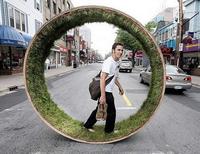
Many of us are so busy being good little hamsters that we never have face time with green space. A group of students from Dalhousie School of Architecture – David Gallaugher, Kevin James, and Jacob Jebailey – decided to remedy this problem with a street-ready grass-lined wheel.
This project reminds us of Rebar’s PARK(ing), which turned metered parking spaces into temporary parks. Both concepts point out not only on our lack of interesting green space, but also our lack of time to enjoy them. We’re huge fans of urban intervention as a means of shaking up normalcy and calling for a change.

Icaro Doria is Brazilian, 25 and has been working for the magazine Grande Reportagem, in Lisbon, Portugal, for the last 3 years. He is part of the team ~ that produced the flags campaign which has been circulating the Earth in chain letters via e-mail.
~
We started to research relevant, global, and current facts and, thus, came up with the idea to put new meanings to the colours of the flags. We used real data taken from the websites of Amnesty International and the UNO.The campaign has been running in Portugal since January 2005. There are eight flags that portray very current topics like the division of opinions about the war in Iraq in the United States, the violence against women in Africa, the social inequality in Brazil, the drug trafficking in Columbia, Aids and malaria in Angola, etc.

The still life on the cover of this week’s issue of Science is not a photograph but a computer-generated rendering of five famous mathematical surfaces. The result, created by Richard Palais of the University of California, Irvine, and graphic artist Luc Benard, is a virtuoso display of modern computer-graphics technology. (Notice how the glassy surfaces are reflected in one another and in the glass-covered, wood-grained tabletop.)
The image is the first-place winner in the illustration category of the 2006 Science and Engineering Visualization Challenge
The links on this page will take you to articles describing the accomplishments of the creative and gifted scientists, artists, and others who put the winning entries together, as well as an online slide presentation that showcases the competition’s winners and honorable mentions.

The ‘Forfun‘ has the body of a normal Smart Fortwo mounted on an all-terrain Mercedes-Benz Unimog 406 series.
I can see myself driving to work in this.
via bog-brush
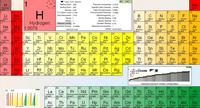
This application was developed by Adams Brian D of Touchspin Design as an aid to his own understanding and that of his students.

SkyCeilings are photographic illusions of real skies that fit into standard ceiling grid systems. Luminous SkyCeilings feature fluorescent or LED lighting that illuminate the translucent images from behind.