Iowa Stars

Iowa Stars

The Iowa Stars will begin a five-year affiliation agreement with the National Hockey League�s Dallas Stars this fall as Iowa plays their inaugural season in the AHL.

The Iowa Stars announced today that the first two games of the 2005-06 inaugural season for the Stars will take place as part of �Opening Weekend� on Thursday, October 6 and Saturday, October 8 against the Peoria Rivermen and the Omaha Ak-sar-ben Knights, respectively.

The full season schedule features a total of 10 games (five home, five road) each against the Stars �West Division� foes including: Omaha, Peoria, Chicago, Milwaukee, Houston and San Antonio.

In addition, the Stars will play Cleveland, Grand Rapids and Manitoba a total of four times (two home, two road) and Rochester, Manchester, Toronto and Hamilton a total of two times (one home, one road).

I’m not really a hockey fan yet. The last time I went to a hockey game, I left after the third period.

Mars

Mars Zoom

For the past several months, we’ve received a lot of questions about an email that’s been making the rounds ~ and it goes something like this: “The Red Planet Mars is about to be spectacular! On August 27, Earth will catch up with Mars. The next time Mars may come this close is in 2287….Mars will look as large as the full moon to the naked eye…etc.”

Here are the facts: Earth and Mars are converging for a close encounter this year on October 30th at 0319 Universal Time. Distance: 69 million kilometers. To the unaided eye, Mars will look like a bright red star, a pinprick of light, certainly not as wide as the full Moon.

Disappointed? Don’t be. If Mars did come close enough to rival the Moon, its gravity would alter Earth’s orbit and raise terrible tides.

You might remember another encounter with Mars, about two years ago, on August 27, 2003. That was the closest in recorded history, by a whisker, and millions of people watched as the distance between Mars and Earth shrunk to 56 million km. This October’s encounter, at 69 million km, is similar.

Press Display

USA Today

PressDisplay� delivers the world’s leading newspapers to you before they appear on newsstands in their home countries.

You can see the front page of several major newspapers, but it costs to look inside. I wanted to sign up for the free trial subscription, but the Auto-Renew and Cancellation Policy scared me.

PressDisplay Auto-Renew and Cancellation Policy
Subscriptions purchased to PressDisplay Service are auto-renewed at the end of the subscription term. However, you may cancel your subscription at any time. In case of cancellation no refund is granted for the unused portion of the cancelled subscription.

I decided to try it. It was a nervous two weeks. I only read USA TODAY, so I would be charged for just one paper – if it came to that.

At the end of my free subscription, I didn’t cancel. I just waited.
No nasty eMail. No bill. Everything is fine.

I guess I worry too much. Now I go there just to browse the front pages.

Rhein/Rhine/Rijn River

Rhein

The Rhine River begins in the Rheinwaldhorn Glacier of Switzerland and flows north and east approximately 820 miles (1,320 km). It is navigable from the North Sea to Basel, Switzerland. Even though it passes through or borders on Liechtenstein,. Austria, Germany, France, and the Netherlands,. 80 percent of it’s ship carrying waters pass through Germany. The entire distance can not support ocean going vessels, they must end their journey in Cologne, Germany. Cologne is located between Koln and Bonn. From there cargo must go by barges pushed by smaller ships until the Rhine reaches the three point intersection of the borders of France, Germany, and Basel, Switzerland.

Because of the multi countries and languages, the river has three names. They are: Rhein, Germany; Rhine, France; and Rijn, Netherlands (Dutch).

Last year we took a boat trip along the Rhine and took some pics.

We got on the boat at Mainz and went to the Castle Liebenstein, where we stayed overnight. It had a beautiful view of the Rhine Valley.

The castle is the source of one of The Finest Legends of the Rhine.

Norman Borlaug Heritage Foundation

Borlaug-Africa

Who is credited with saving more lives than anyone in history “one billion lives” and has been called one of the 20th century’s ten greatest contributors to humankind?

Need a hint? He’s in the National Wrestling Hall of Fame.

Another one? He’s the winner of the 1970 Nobel Peace Prize.

More? He threw out the first pitch at Fenway Park on June 9, 2004.

For over half a century, Dr. Norman Borlaug has fought to keep poverty and hunger at bay. Known as “The Father of the Green Revolution” Borlaug is best known for his hybrid wheat and modern agricultural techniques, but his success is largely related to his work as an educator and policy maker. Dr. Borlaug grew up on a farm near Cresco, Iowa, never forgetting the lessons of the farm, or the strong influence his grandfather had on his education.

Surrounded by the rich soil and the green of Iowa, it’s hard to imagine, or understand, how anyone could need more food. Yet world hunger is not abstract, or untamable: fifteen years ago, 30,000 people were dying from hunger each day; twenty years ago, it was 40,000 people. Advances in the war against hunger are being made.

“I personally cannot live comfortably in the midst of abject hunger and poverty and human misery, if I have the possibility of doing something about improving the lives of these many young children.” -Norman Borlaug

“We cannot choose between feeding malnourished children and saving endangered wild species. Without higher yields, peasant farmers will destroy the wild lands and species to keep their children from starving. Sustainably higher yields of crops and trees are the only visible way to save both.” -Norman Borlaug

If people want to believe that the organic food has better nutritive value, it’s up to them to make that foolish decision. But there’s absolutely no research that shows that organic foods provide better nutrition. As far as plants are concerned, they can’t tell whether that nitrate ion comes from artificial chemicals, or from decomposed organic matter. If some consumers believe that it’s better from the point of view of their health to have organic food, God bless them. Let them buy it. Let them pay a bit more. It’s a free society. But don’t tell the world that we can feed the present population without chemical fertilizer. That’s when this misinformation becomes destructive. -Norman Borlaug

The Foundation recognizes Dr. Borlaug’s contributions to the world with a primary goal of reaching American K-12 schools, colleges and communities informing them of his work and values. Through the Borlaug Residency Program, students and communities are encouraged to serve humankind with the same convictions and tenacity that has served Dr. Borlaug throughout his life.

True/False Quiz

Living History Farms

Living History Farms

Living History Farms in Urbandale, Iowa, tells the amazing story of how Iowans transformed the fertile prairies of the Midwest into the most productive farmland in the world. While at the 550-acre open-air museum, visitors travel at their own pace through five historical time periods spanning 300 years. On-site interpreters provide a unique learning environment of seasonal activities and demonstrations. A complete visit lasts three to four hours.

Every day at Living History Farms presents new activities to help you Get Your Grip on history.

The farming techniques practiced by the Ioway Indians in 1700 pre-dated history and varied somewhat from European methods. Ioway farmers raised corn, beans and squash.

Activities included Tanning a Deer Hide.

Until pioneer families earned enough money to purchase modern 1850 technology, they relied on older farming methods. For example, women prepared food over an open fire even though wood-burning cookstoves were available. The majority of people who settled in Iowa in the 1840s and 1850s came from the Eastern United States ~.

Activities included Making Soap.

In the 1875 town, you can see early evidence of the Industrial Revolution in the mass-produced furniture of the upper-class home, the factory goods in the general store, and the labor-saving machinery in the carpenter’s shop. When railroads arrived at towns like this, the craftsmen gradually disappeared, being undersold by eastern factories, and the towns shifted even more heavily to service and retail functions.

Activities included Binding Brooms

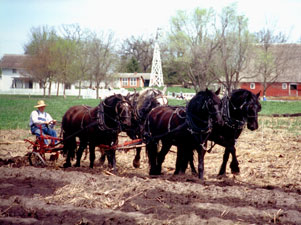
Technology had reached Iowa farms in 1900, by way of the hand-crank telephone, Acorn cook stove, and updated farm equipment, such the horse-drawn plow, planter, hay press and more.

Activities included hauling manure.

TravelAmerica Magazine’s top 20 tours in the United States includes Living History Farms as a highlighted stop.

I live near Living History Farms, and I think it’s a very high quality operation. I recommended it to anyone traveling through Iowa.

Chesapeake and Ohio Canal

C&O Canal

One of the best preserved and least altered of old American canals, the Chesapeake and Ohio grew from Washington’s vision of linking the valleys of the early west with the east by “ties of communication.” The Potomac Company fostered by Washington to improve navigation of the Potomac transferred its rights in 1828 to the Chesapeake and Ohio Company organized to connect the Ohio at Pittsburg with Georgetown by a continuous canal. In October 1850 after 185 miles were built the construction ceased at Cumberland. Until 1924 trade continued on the old canal. Today, it is a memorial to national progress and the canal era.

The history of the canal runs parallel with the history of the B&O Railroad. You can check Steve Okonski’s B&O RR Photo Tours site for a mile-by-mile guided tour of the B&O routes heading out from Baltimore.

The Dammed Mississippi

Dam 13

Among those involved in remaking the Mississippi was a Germanborn mapmaker, Henry Peter Bosse. Coming to America in 1870, the twenty-six-years-old immigrant joined the Corps four years later and was sent to draw the river from St. Paul, Minnesota to St. Louis, Missouri. But the draftsman did more; he took at least 350 large format photographs between 1883-93, as he worked his way 729 miles downstream from the upper limit of navigation.

“U.S. Agriculture depends utterly on a viable transportation network to enable farmers to access the world markets. We produce far more commodities such as corn than we could ever hope to consume domestically, and the competition from the export market forces domestic users to bid competitively for those commodities, keeping prices above the cost of production.

Water transportation moves 16% of our nation’s freight for 2% of the freight cost. Compared to alternative modes, barges save shippers and consumers more than $7 billion annually.

One gallon of fuel can move one ton of cargo 522 miles by barge, 386 miles by rail and 59 miles by truck.

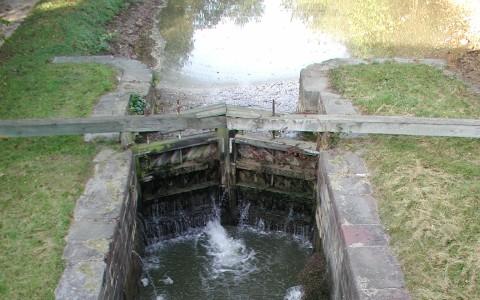
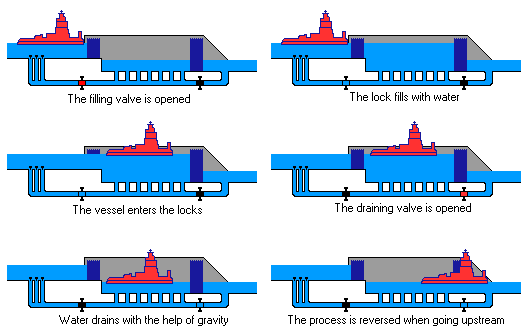
Locks Working

Take a dam tour.

Watch the dam cam.

The Mississippi River Basin is made up of several Subbasins.

Map of Iowa’s locks and dams along the Upper Mississippi.

This photo was taken moderately high.

This photo was taken dam high.

More dam photos.

The dams do not control floods; during high water, the dam gates are raised out of the water. Below St. Louis, the river is deep enough so that locks and dams are not needed for commercial navigation.

In general, dams transform rivers into lakes and impoundments. The resulting changes in water depth, water currents, temperature, and restructured fish and algal communities can negatively affect freshwater mussels.